


Choosing the best CRM for real estate sounds simple until you’re staring at a shortlist of twelve platforms, each promising to “transform your pipeline.” Too lightweight, and you’ll outgrow it the moment your team scales. Too complex, and your agents will quietly go back to spreadsheets by week three.
This guide cuts through the noise. We’ve evaluated the best CRM software for real estate agents based on how well each platform actually handles the way real estate deals move — not just how many features they list on a pricing page.
This guide covers the best CRM software for real estate agents and agencies in 2026 with honest pros, cons, pricing, and a clear decision framework at the end.
Full transparency before we start: ENWAY is a certified Salesforce implementation partner. We have configured Salesforce for real estate businesses of all sizes, and we have also watched clients walk away from it toward simpler tools that suited them better. That experience is what makes this guide useful. We are not here to sell you a platform. We are here to help you pick the right one, and sometimes that is not Salesforce.
What Is a Real Estate CRM — and Why Does It Matter?
A real estate CRM (Customer Relationship Management) system is software that centralises contact management, deal tracking, lead follow-up, and client communication in one place. For real estate professionals, it replaces the chaos of scattered spreadsheets, sticky notes, and missed callbacks with a structured, automated workflow.
The best CRM system for real estate does more than store contacts. It:
- Tracks every lead from first inquiry to closed deal
- Automates follow-up sequences so no lead goes cold
- Gives managers visibility into agent activity and pipeline health
- Integrates with listing portals (Zillow, Realtor.com, MLS) and marketing tools
- Surfaces the right contact at the right time — before a competitor does
For a solo agent, the right CRM doubles as a virtual assistant. For an agency with 20+ agents, it becomes the operational backbone of the business.
Best CRM for Real Estate: Quick Comparison
| CRM | Best For | Starting Price | Standout Feature |
|---|---|---|---|
| Salesforce | Growing agencies needing customization | $25/user/month | Unmatched flexibility + automation |
| Follow Up Boss | Teams & high-volume agents | $58/user/month | Lead routing + automatic follow-up |
| HubSpot | Agents who want to start for free | Free version, paid from $7/user/month | Best-in-class marketing tools |
| Wise Agent | Transaction management focus | $49/month for up to 5 users | Built-in transaction checklists |
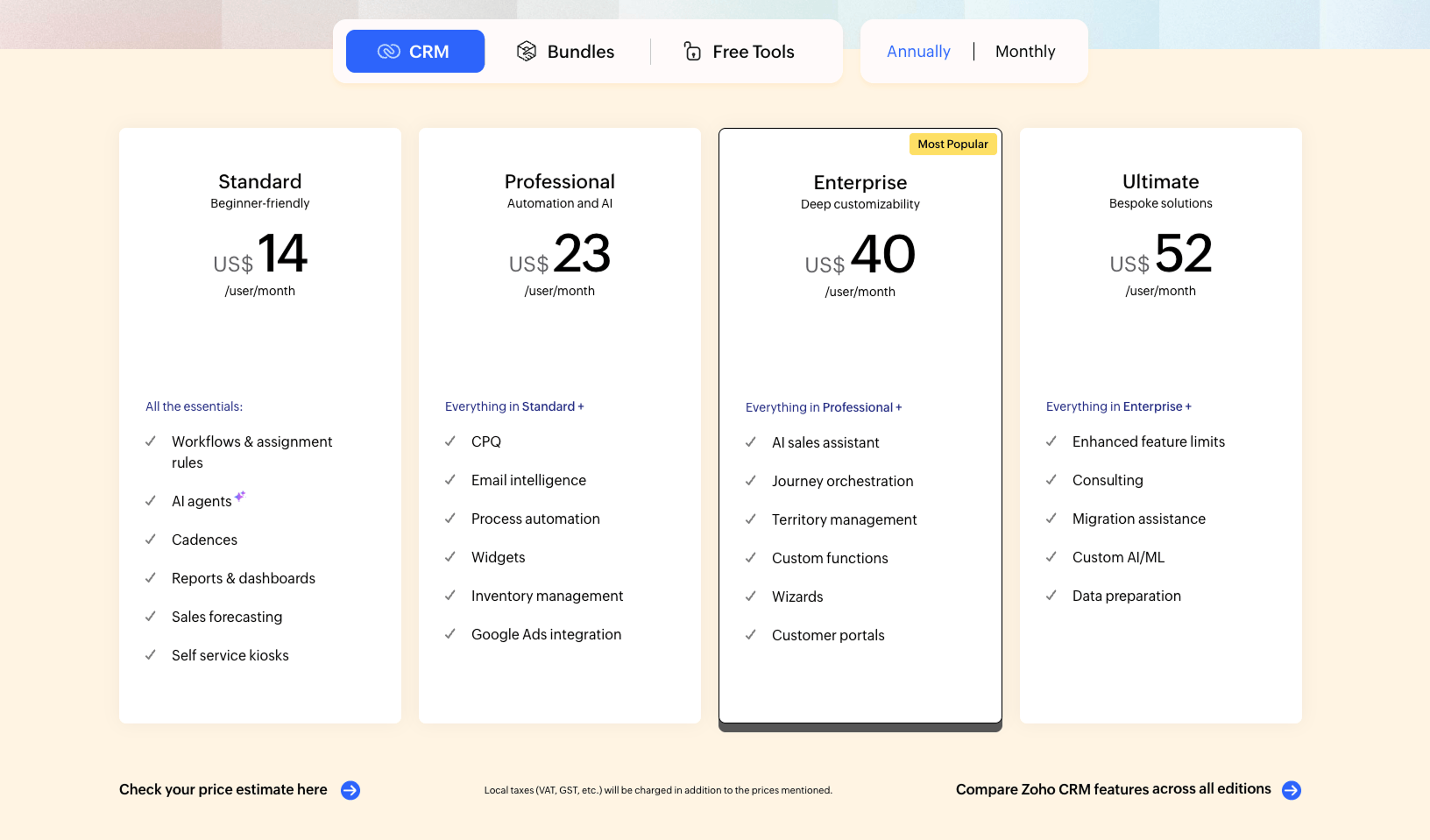
| Zoho CRM | Budget-conscious growing teams | $14/user/month | Canvas (Custom Interface Builder) |
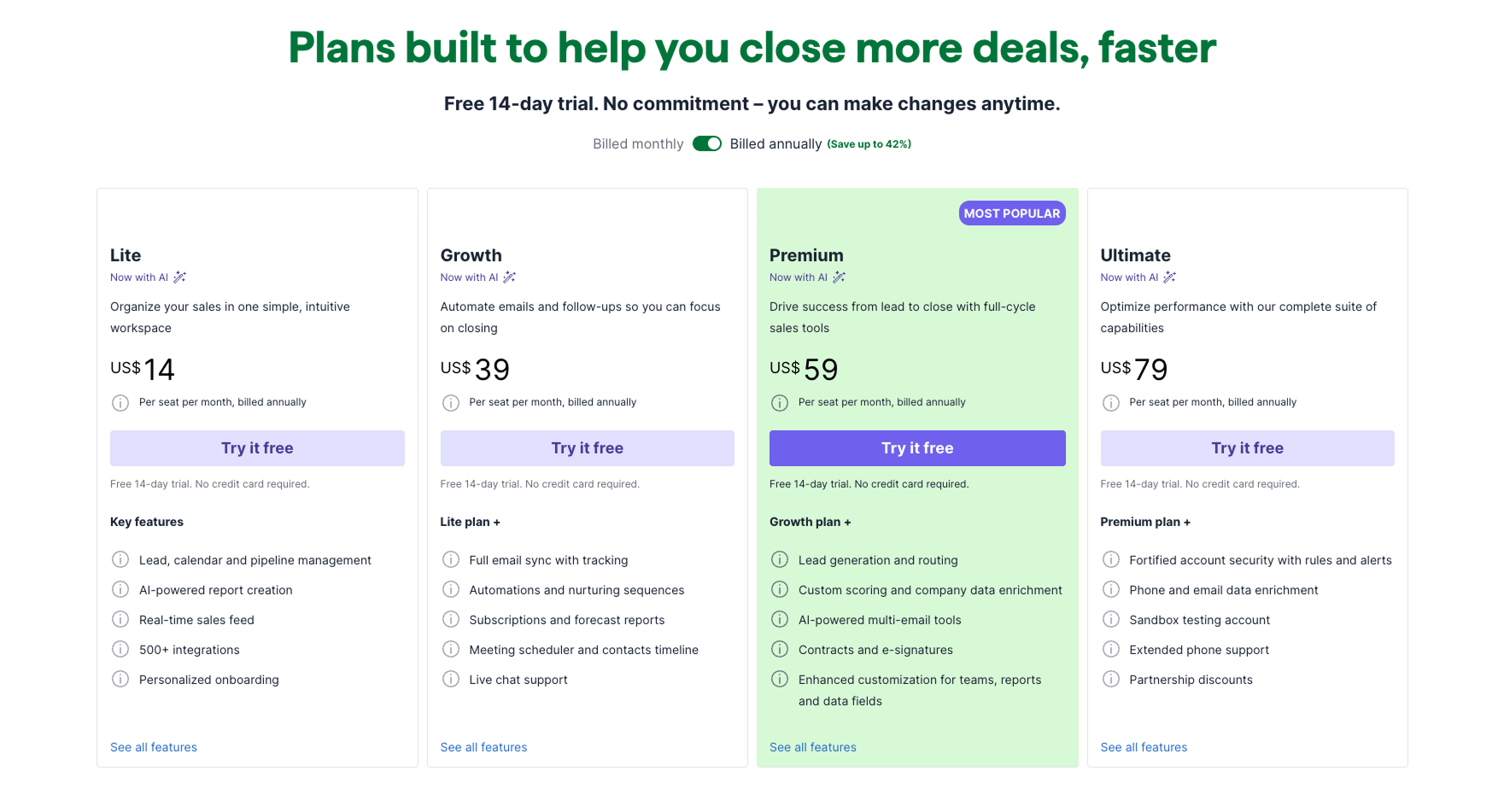
| Pipedrive | Agents who think in pipelines | $14/user/month | Visual deal pipeline |
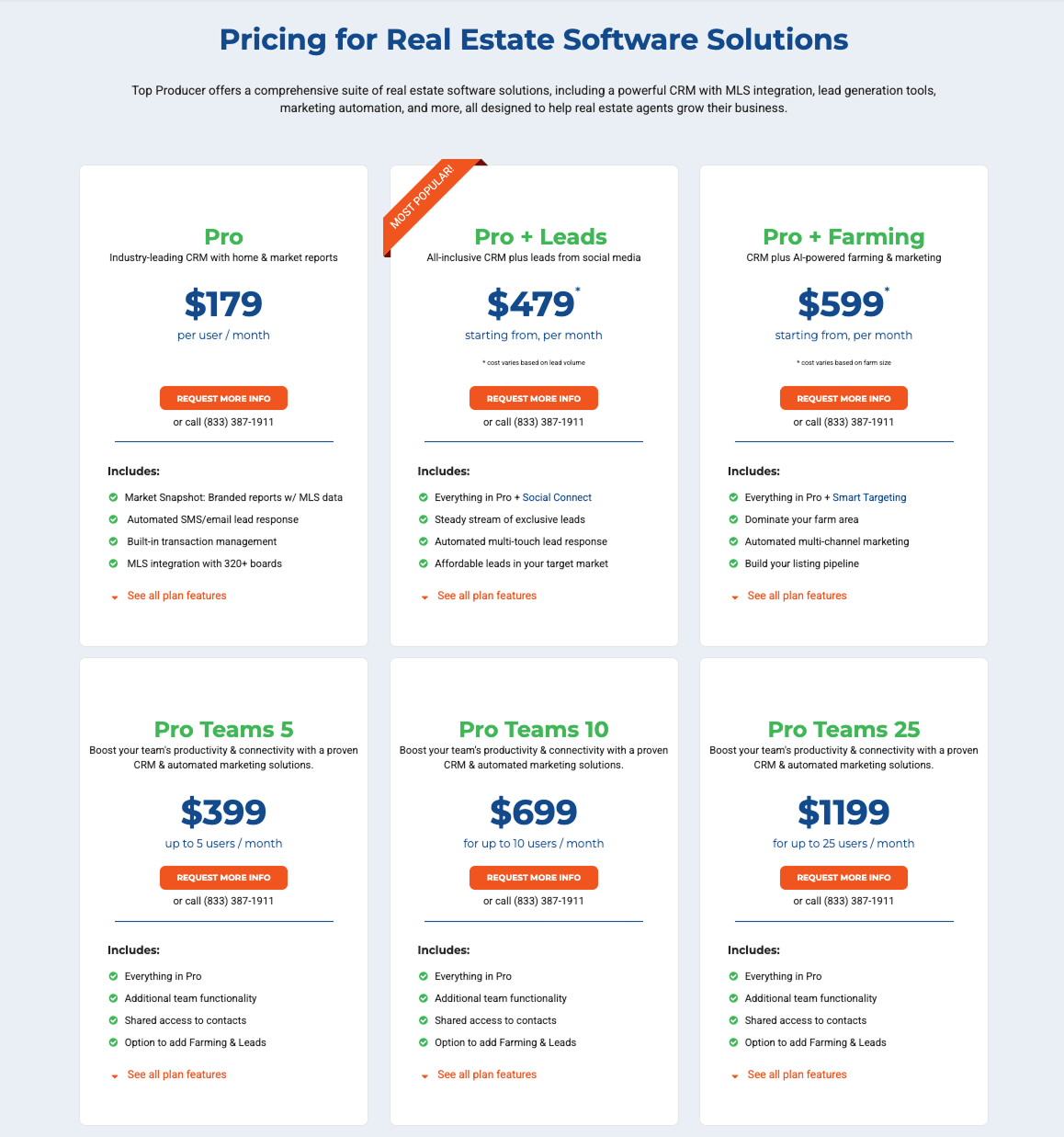
| Top Producer | Agents focused on referrals | $179/user/month | Automated past-client market reports |
The Best CRM Software for Real Estate Agents: Full Reviews
1. Salesforce
Best for: Small scaling and mid-to-large real estate agencies, franchises, and brokerages that need deep customisation, enterprise-level automation, and a platform that grows with the business.
Salesforce is a highly powerful CRM. Custom objects for listings, transactions, and commissions; automated workflows that trigger across departments; reporting dashboards that give leadership real-time visibility into pipeline, agent performance, and deal velocity — none of the real estate-specific platforms come close to what Salesforce can do at this level.
The challenge is that Salesforce requires proper implementation to deliver on its potential. Out of the box, it’s not a ready-to-use real estate tool. For large agencies, this is an asset: you can build exactly what your operation needs. For smaller teams, it can be a barrier.
Key features:
- Fully customizable objects, pipelines, and automation rules
- Einstein AI for predictive lead scoring and activity capture
- AppExchange marketplace with real estate-specific add-ons (Moxi, Propertybase, etc.)
- Enterprise-grade reporting and forecasting
- Seamless integration with virtually any third-party tool
What we like: The customization ceiling is essentially unlimited. You can build workflows, automations, and reporting views that perfectly mirror how your agency actually operates — not a generic template you are forced to work around.
What to watch: Implementation takes real expertise. A poorly configured Salesforce environment is often worse than a simpler tool done right. Working with a certified Salesforce consultant for real estate is strongly recommended for agencies serious about getting ROI quickly.
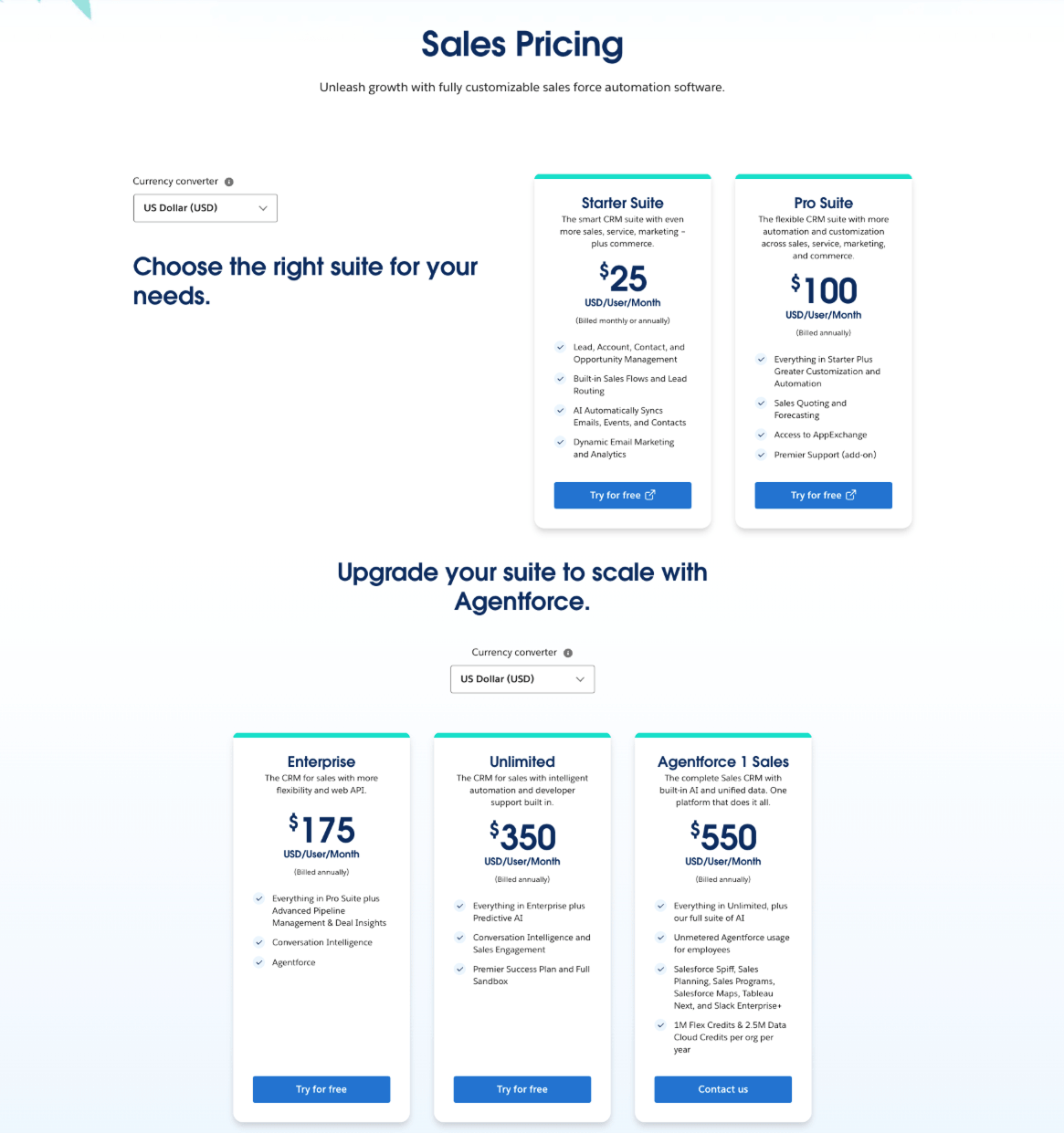
Pricing: Sales Cloud from $25/user/month (Starter Suite); Enterprise and Unlimited tiers start at $175 and $350/user/month, respectively. For full automation capabilities, we recommend at a minimum the Enterprise tier. Explore the Salesforce editions comparison here.
Increase sales productivity by 29% using CRM
ENWAY is a 5-star Salesforce implementation partner, completing projects in Europe, the US, the UK, and the Emirates. We help you choose the right Salesforce edition and get started with CRM.
2. Follow Up Boss
Best for: Real estate teams processing 50+ leads per month who need fast lead routing and multi-channel follow-up automation.
Follow Up Boss is one of the most widely adopted CRMs in residential real estate, and for good reason. It was built specifically for agents — not retrofitted from a generic sales tool. The platform excels at lead distribution, meaning when a new inquiry arrives from Zillow or your website, it is automatically routed to the right agent within seconds.
Key features:
- Automatic lead import from 200+ sources (Zillow, Realtor.com, Facebook Leads, IDX websites)
- Action plans (automated follow-up drip sequences by lead type)
- Two-way texting and email from inside the platform
- Call recording and voicemail drop
- Agent and lead source performance reporting
- FUB AI (Smart summaries, Suggested tasks, Predictive lead prioritization)
- Mobile app for agents on the move
What we like: The speed-to-lead functionality is genuinely best-in-class. The moment a lead registers on your site or comes in from a portal, Follow Up Boss pings the assigned agent and starts the follow-up sequence — all without manual input.
What to watch: The reporting suite, while functional, is not as deep as enterprise-grade platforms like Salesforce. Also, businesses with highly customized processes and functionality requirements may eventually hit platform limitations.
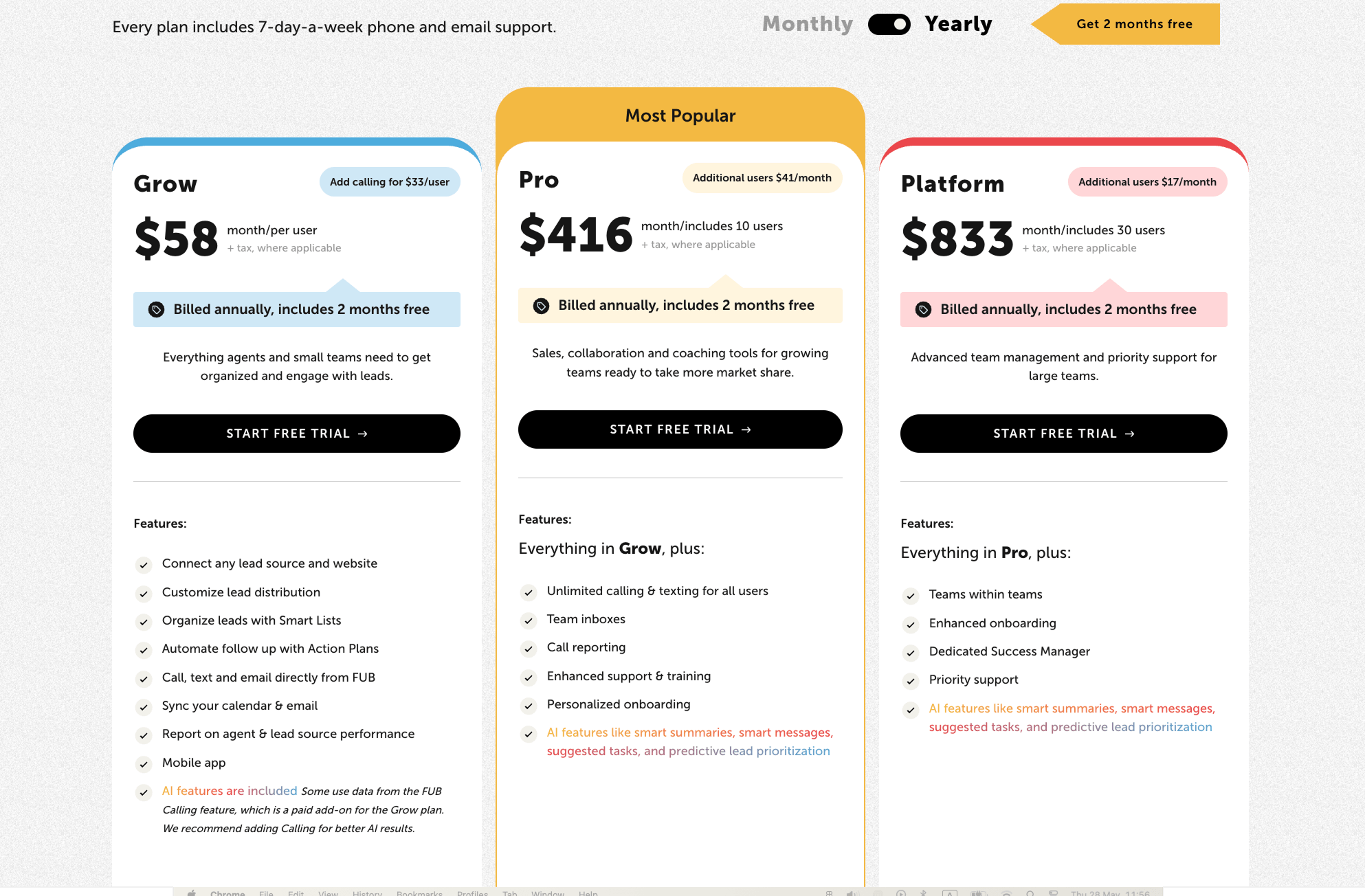
Pricing: From $58/user/month (when billed annually). Team plans start at $416/month for 10 users.
3. HubSpot CRM — Best Free CRM for Real Estate Agents Starting Out
Best for: Solo agents or small teams who want a professional CRM at minimal cost and do not yet need deep MLS integration.
HubSpot‘s free tier is genuinely capable, not a stripped-down demo. For a real estate agent who primarily uses email for nurture campaigns, wants pipeline visibility, and does not need native MLS syncing, HubSpot is an excellent starting point. The interface is clean, the onboarding is fast, and the email marketing tools are powerful even on the free plan.
Key features:
- Unlimited contacts and deals on the free tier
- Email sequences and templates
- Meeting scheduling integration (Calendly-style, built-in)
- Deal pipeline with customisable stages
- Live chat and web form integrations
- Upgrade path to Marketing Hub for advanced automation
What we like: The combination of CRM + marketing tools in one platform is rare at this price point. You can run email drip campaigns, manage your pipeline, and track website visitor behaviour all from the same dashboard.
What to watch: Native real estate integrations (Zillow, MLS, IDX) are limited compared to purpose-built real estate CRMs. Most agents use third-party tools like Zapier to bridge the gap, which adds cost and complexity.
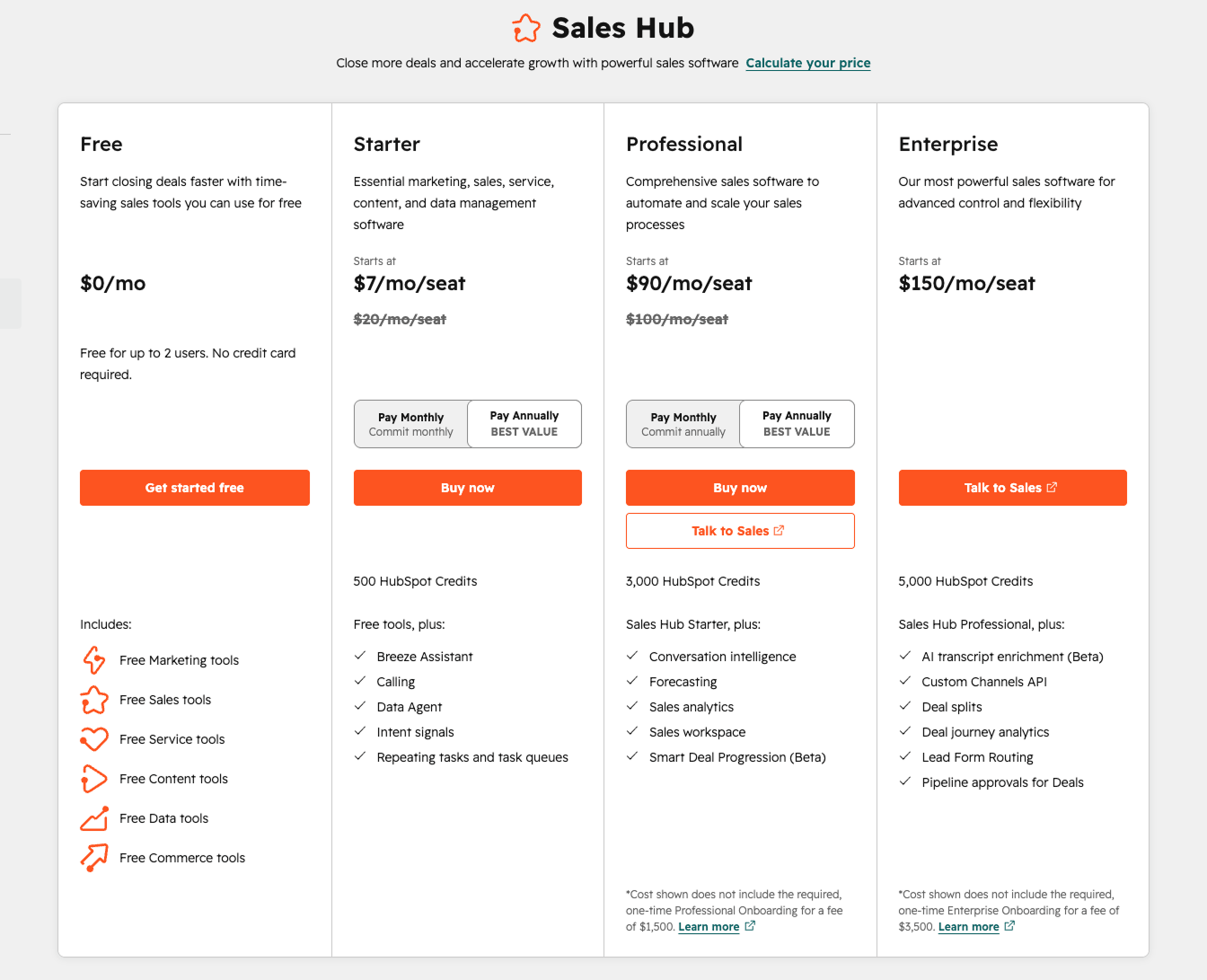
Pricing: Free core CRM. Paid plans range from $7/user/month (Starter Sales Hub, billed annually) to $150/user/month (Enterprise Sales Hub). Real estate teams typically need the Professional tier or higher for automation features. Additional solutions, such as Marketing Hub or Service Hub, can be added to the bundle.
4. Wise Agent
Best for: Solo agents and small real estate teams who want a comprehensive feature set at a predictable flat monthly cost.
Wise Agent punches above its price class. For a single flat monthly rate, it includes contact management, transaction management, email marketing, a landing page builder, and phone dialer integration. The flat-rate pricing (not per-user) makes it especially attractive for small teams.
Key features:
- Contact and transaction management in one place
- Built-in drip campaigns and email newsletters
- Landing page builder for lead capture
- Time management and task automation
- Referral tree for tracking referral sources
- 24/7 customer support (unusually responsive for this price point)
What we like: The value proposition is hard to argue with. At $49/month flat for a team of up to five, it includes features that cost multiples of that on competing platforms.
What to watch: It lacks the behavioural lead tracking and deep MLS integration that high-volume teams need. It works best as a relationship management tool rather than a full lead-generation engine.
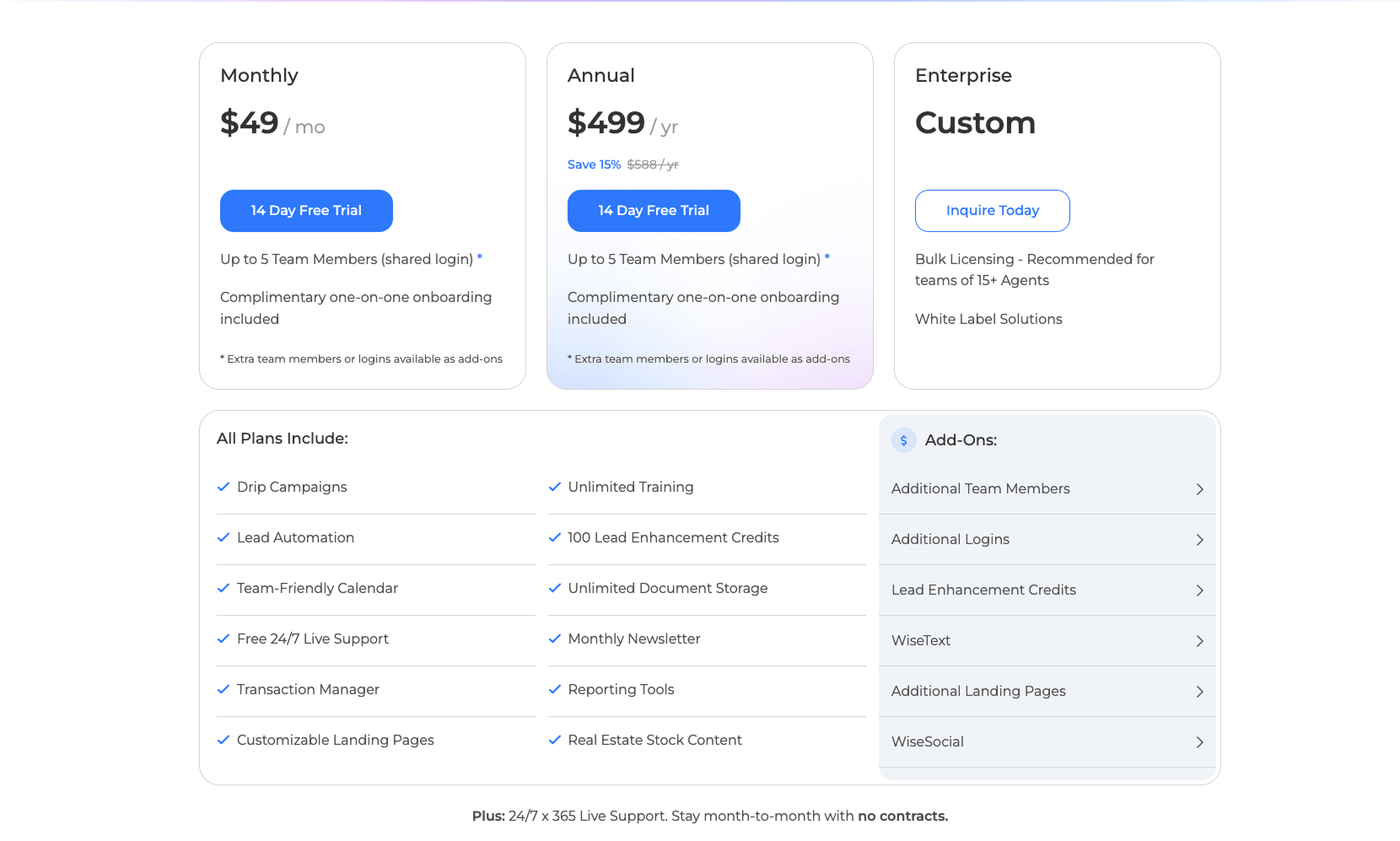
Pricing: $49/month for up to 5 users, or $499/year when billed annually. Each additional 5-user pack costs $20/user/month.
5. Zoho CRM
Best for: Independent agents or small teams who want a highly customisable, affordable CRM and are comfortable configuring it for a real estate workflow.
Zoho CRM is one of the most feature-rich CRMs at its price point, and its breadth is both its greatest strength and its main challenge. Out of the box it is not a real estate CRM — but with Zoho’s workflow builder, custom modules, and a wide range of integrations, it can be shaped into a highly effective tool for agents who invest time in the setup. It also sits inside the wider Zoho ecosystem (Zoho Campaigns, Zoho Books, Zoho Desk), which makes it attractive for agents who want a connected suite of business tools.
Key features:
- Custom modules and fields (build your own property and transaction records)
- AI assistant (Zia) for lead scoring, deal predictions, and anomaly detection
- Multi-channel communication: email, phone, social, live chat — all logged
- Workflow automation and blueprint process management
- Extensive integration library (Zapier, Mailchimp, Google Workspace, and 800+ more)
- Free tier available for up to 3 users
What we like: The automation depth at this price is exceptional. Zoho’s Blueprint feature lets you map out an exact deal process — from first contact through to closing — and enforce it as a workflow, reducing the chance of steps being skipped.
What to watch: MLS and IDX integrations are not native. You will need Zapier or a custom API connection to bridge Zoho with listing portals, which adds complexity. Agents without a technical background may find the initial configuration overwhelming without outside help.
Pricing: Free for up to 3 users. Paid plans from $14/user/month (Standard) to $52/user/month (Ultimate). Most real estate use cases fit the Enterprise tier at $40/user/month.
6. Pipedrive
Best for: Agents and small teams who want an intuitive, visual deal pipeline and a CRM that is fast to set up and easy to use daily.
Pipedrive was built with one core idea: salespeople should spend their time selling, not managing software. The result is a CRM with one of the cleanest, most visual interfaces on the market — a drag-and-drop pipeline where you can see every deal at every stage at a glance. For real estate agents who want clarity over complexity, Pipedrive is a refreshing alternative to heavier platforms.
Key features:
- Visual drag-and-drop deal pipeline with customisable stages
- Activity-based selling reminders (calls, meetings, follow-ups)
- Smart Contact Data (auto-enriches contact records from public sources)
- Email sync with tracking (open rates, clicks, reply detection)
- Automations for repetitive tasks (moving deals, sending emails, assigning tasks)
- Marketplace with 400+ integrations, including Zapier, Mailchimp, and DocuSign
What we like: The pipeline view is genuinely best-in-class for visual clarity. For agents juggling multiple active buyers and sellers simultaneously, being able to drag a contact from “Viewing Scheduled” to “Offer Made” in one click keeps the workflow fast and satisfying to use.
What to watch: Like Zoho, Pipedrive is a general-purpose CRM — there are no native MLS or IDX integrations. It also lacks the real estate-specific automation depth of Follow Up Boss or Top Producer. It works best for agents who generate leads through personal networks and outbound activity rather than high-volume portal leads.
Pricing: From $14/user/month (Essential) to $79/user/month (Ultimate) if billed annually. The Professional plan at $39/user/month is the most popular tier for active agents and includes automations and reporting.
7. Top Producer
Best for: Experienced agents with strong existing databases who want to systematically generate referrals and past-client business.
Top Producer has been in the real estate CRM market longer than most of its competitors, and its latest version has modernised significantly. Its strongest suit is relationship nurturing: managing anniversaries, market update emails, and systematic past-client touchpoints that turn a closed deal into a referral engine.
Key features:
- Market Snapshot automated property reports for past clients
- Social Connect (pulls social media data into contact records)
- FiveStreet lead response tool
- MLS/IDX integration for property matching
- Email and print marketing campaigns
- Team accountability tools
What we like: The Market Snapshot feature is a genuine differentiator — it automatically sends customised property value reports to past clients on a schedule, keeping you top of mind without manual effort.
What to watch: The platform’s lead generation tools are less competitive than Follow Up Boss for agents focused on cold lead volume. It shines most for agents leveraging an existing book of business. And despite being one of the pricier options, it lacks Salesforce’s customization capabilities.
Pricing: From $179/user/month for the base tier.
How to Choose the Best CRM System for Real Estate
Not every platform is right for every agent or agency. Here is how to choose:
If you are a solo agent managing under 100 contacts: → Start with HubSpot free or Wise Agent. Low cost, quick setup, zero risk.
If you are a solo agent or small team running high lead volume: → Follow Up Boss is purpose-built for this. The lead routing speed and automated follow-up sequences alone are worth the cost.
If you are a growing team of 5–20 agents: → Follow Up Boss for the best UX and real estate-specific automation. Salesforce is also worth considering if you anticipate scaling fast — starting on the right foundation avoids a costly platform migration later.
If you are an SMB agency of 10–50 agents ready to invest in infrastructure: → Salesforce is a stronger long-term bet than many teams expect. At the SMB tier, Salesforce Sales Cloud starts from $25/user/month — competitive with purpose-built real estate tools — and when configured for real estate it covers MLS integration, transaction management, and custom agent workflows. The key investment is implementation, not just licensing.
If you run a brokerage or franchise and want enterprise-grade control: → Salesforce is the clear choice. No other platform matches its depth, customisation, and scalability. Budget for a certified implementation partner — the ROI depends heavily on getting the configuration right from day one.
If referrals and past-client nurture are your primary growth channel: → Top Producer. Built specifically for this use case.
Key questions to answer before choosing:
- How many leads per month do you receive? (Impacts need for automation and routing)
- Do you need a built-in IDX website, or do you already have one?
- How many agents need access? (Affects per-user vs. flat pricing decisions)
- Do you use specific portals (Zillow Premier Agent, Realtor.com)? (Verify native integrations)
- What is your tech comfort level? (Salesforce requires more investment upfront; Wise Agent and HubSpot require less)
- Are you planning to grow headcount significantly in the next 2–3 years? (If yes, Salesforce scales without a platform change; smaller tools may not)
What to Avoid When Choosing a Real Estate CRM
Choosing on price alone. A $39/month CRM that your agents do not use costs far more than a $150/month platform they use every day.
Ignoring mobile app quality. Real estate is a mobile-first industry. If the CRM app is clunky, your agents will default to texting from their personal phones and the data never makes it into the system.
Skipping the integration check. If the CRM does not natively connect to your lead sources (Zillow, your IDX site, Facebook Ads), you are adding manual data entry — and manual entry means missed leads.
Underestimating implementation time. Even intuitive platforms take 2–4 weeks to configure properly: importing contacts, setting up automations, training agents. Plan for this before launch day.
Frequently Asked Questions
Follow Up Boss is the top choice for most active agents and teams due to its real estate-specific design, fast lead routing, and strong portal integrations. For growing agencies and brokerages, Salesforce offers unmatched depth and customization.
For smaller teams of 5–20 agents, Follow Up Boss is the leading option, with strong real estate-specific automation and an interface agents actually adopt. For growing SMB agencies of 10–50 agents with ambitions to scale, Salesforce is increasingly the right call — the entry cost is comparable to mid-tier alternatives, but the platform grows with you rather than forcing a migration later. For 50+ agents or franchise operations, Salesforce is the standout choice.
HubSpot’s free CRM is genuinely capable for agents starting out, with a clean interface and solid email marketing tools. Wise Agent ($49/month flat) is the best paid option for small teams that need more real estate-specific features without per-user pricing.
A generic CRM can work well — particularly Salesforce, which combines the world’s most powerful CRM engine with a real estate-specific layer covering MLS integration, transaction management, and agent workflows. For growing agencies, this hybrid approach often outperforms purpose-built tools that hit a ceiling at scale. Pure generic CRMs like HubSpot standalone require more manual configuration to serve real estate workflows, but are a solid starting point for smaller operations.
Yes — and it is not just for large enterprises. Salesforce is a viable and increasingly popular choice for SMB agencies and growing teams that want a platform built for the long term. Salesforce Sales Cloud starts from $25/user/month, and when configured for real estate it covers everything from lead capture and MLS integration to transaction management and agent performance reporting. Smaller agencies that invest in a proper implementation often find it competes directly with purpose-built tools at similar cost — with significantly more room to grow.
At minimum: contact and pipeline management, lead source integration (Zillow, MLS, IDX), automated follow-up sequences, two-way texting, mobile app, and basic reporting. Higher-volume teams should also look for lead routing, call recording, and behavioural triggers.
Our Recommendation
The question of which CRM is best for real estate has no single answer — but it has the right answer for each situation:
- Solo agents, low to mid volume: Start with HubSpot (free) or Wise Agent ($49/month)
- Active agents and small teams: Follow Up Boss is the best all-round choice
- Growing teams of 10–50 agents: Salesforce deserves serious consideration — the entry cost is closer than most people expect, and the scalability ceiling is far higher
- SMB agencies with growth ambitions: Salesforce, configured at the right tier — avoids a disruptive platform migration when you hit the ceiling of lighter tools
- Large agencies and enterprises: Salesforce, implemented properly with a certified partner
The biggest mistake most real estate professionals make is picking a CRM and then under-investing in the setup. The best CRM for your real estate business is the one that gets configured correctly, adopted by your agents, and actually used every day. That outcome depends as much on implementation as it does on the platform itself.