


Updated July 2026 to reflect the latest version of Agentforce, including Agentforce 360 and current pricing. Agentforce is changing fast, so check Salesforce’s official pages for the most current details.
Here is a number worth sitting with: 67% of customers feel frustrated when their problems are not solved quickly. And most sales reps still spend the bulk of their week on admin and other non-selling work instead of actually selling.
Salesforce built Agentforce to close that gap. It is a platform where people and autonomous AI agents work alongside each other to get more done and give customers faster answers.
So what is Agentforce, really, and does it live up to the hype? In this guide, I will walk through what it is, how it works, how it differs from ordinary chatbots and from Einstein, what it costs today, and where it still has rough edges.
Prefer watching? Check out the video below for a quick Agentforce overview!
Agentforce is Salesforce’s agentic AI platform for building, testing, and deploying autonomous AI agents across sales, service, marketing, commerce, and internal operations. The current release, Agentforce 360, brings the agent platform, Data 360, the Customer 360 apps, and Slack together into a single system.
What is Agentforce?
Agentforce is Salesforce’s platform for building and running autonomous AI agents. An agent is more than a scripted chatbot. It can reason through a request, decide what to do, take real actions in your systems, and pass the conversation to a human when it needs to.
You can switch on Salesforce’s ready-made agents, adapt them, or build your own from scratch with familiar tools like Flows, Prompt Templates, and Apex. Because each agent is grounded in your own trusted data, it answers from your actual business context rather than from a generic model’s best guess.
Salesforce calls agentic AI the “third wave” of enterprise AI. The first wave was predictive models, the second was generative AI and the copilots that help a person as they work, and the third is autonomous agents that can carry out multi-step tasks on their own. That last step is the real shift. A copilot suggests something and waits for you, whereas an agent goes ahead and does the work.
Source: salesforce.com
How does Agentforce work?
At a high level, an Agentforce agent works in a loop. It reads the request, reasons about what is needed, pulls the right data, takes an action, and checks the result, then repeats until the job is done or it hands off to a person.
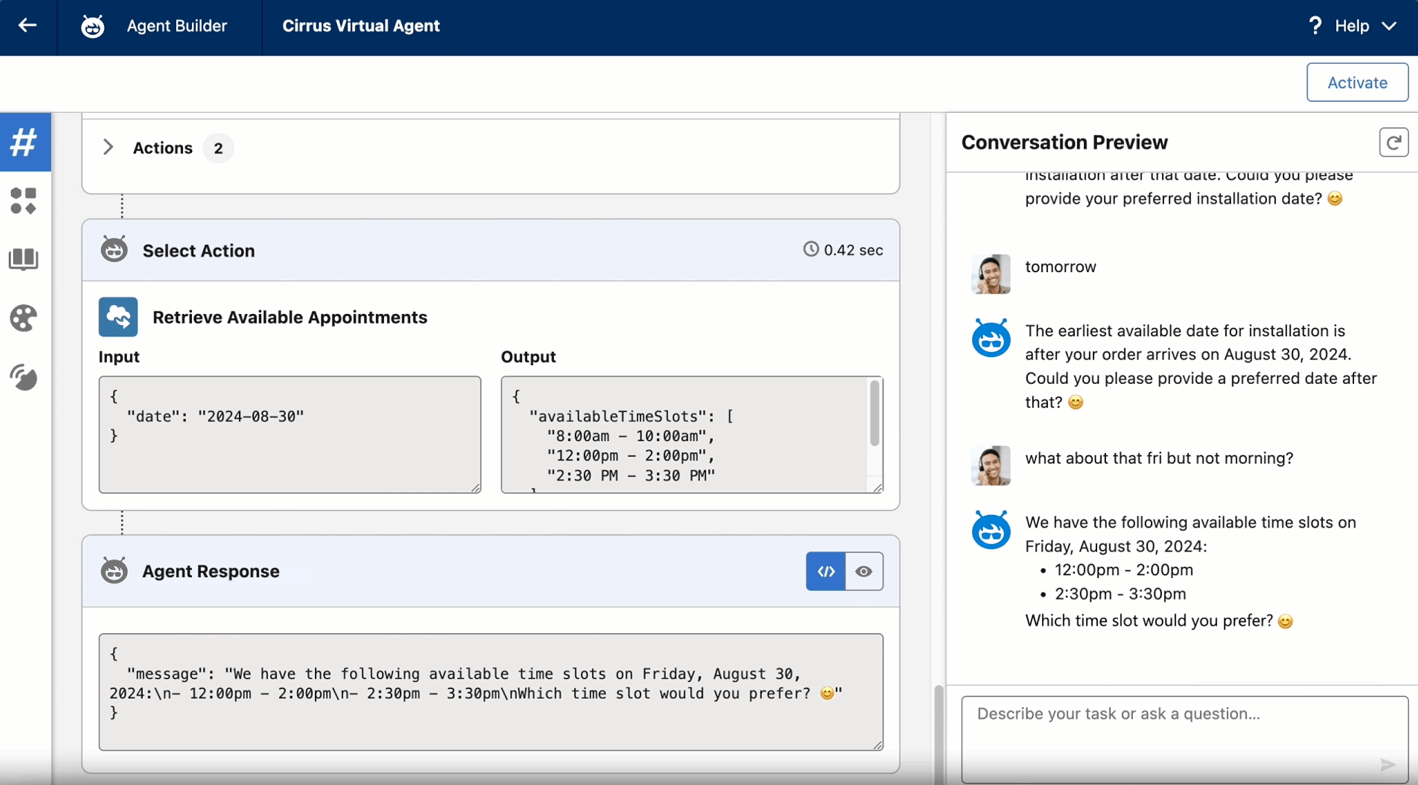
To build one, you describe what the agent should do in plain language inside Agentforce Builder. You organize its knowledge and abilities into topics such as “order status” or “returns”, attach actions to each topic (querying a record, running a Flow, calling an API, sending an email), and write the instructions and guardrails that keep it on track. Then you can test it in a conversational workspace, watch how it reasons, and refine it before it ever reaches a customer.
Two things keep the answers grounded rather than improvised. First, agents connect to Data 360 (Salesforce’s data platform, previously called Data Cloud) and use retrieval-augmented generation, or RAG, to pull fresh, relevant records before they answer, so responses come from your live data instead of stale training. Second, the Einstein Trust Layer handles security and privacy, with features like data masking, toxicity detection, and zero data retention with the underlying models.
What is the Atlas Reasoning Engine?
If the agent has a brain, it is the Atlas Reasoning Engine. Atlas is what lets an agent handle a request it has never seen before. Instead of matching your message to a preset answer, it plans an approach. It works out what you are asking, decides what information and which actions the task needs, and then carries them out.
Salesforce built Atlas to work through a problem the way a person would, sharpening its understanding as it gathers context and pulling in only the data that is actually relevant. That planning step is what separates an agent that can adapt on the fly from a chatbot that can only follow the branches someone set up in advance.
What are the parts of an Agentforce agent?
Every Agentforce agent, whether it is prebuilt or one you build yourself, comes down to five building blocks. Once these make sense, the rest of the platform is much easier to follow.
Role. What the agent is there to do. It sets out the jobs it handles and the goals it is working toward for your team.
Trusted data. The information it draws on, including company knowledge, CRM records, data unified in Data 360, and any approved external sources.
Actions. What it can actually carry out, such as running a Flow, using a prompt, calling an API, or executing Apex, triggered by a request or a rule.
Guardrails. The rules for what it can and cannot do, including the point at which it should stop and pass a complex issue to a person.
Channels. Where it shows up, from your website, CRM, and mobile app to Slack, messaging apps, and voice.
What agents does Agentforce offer?
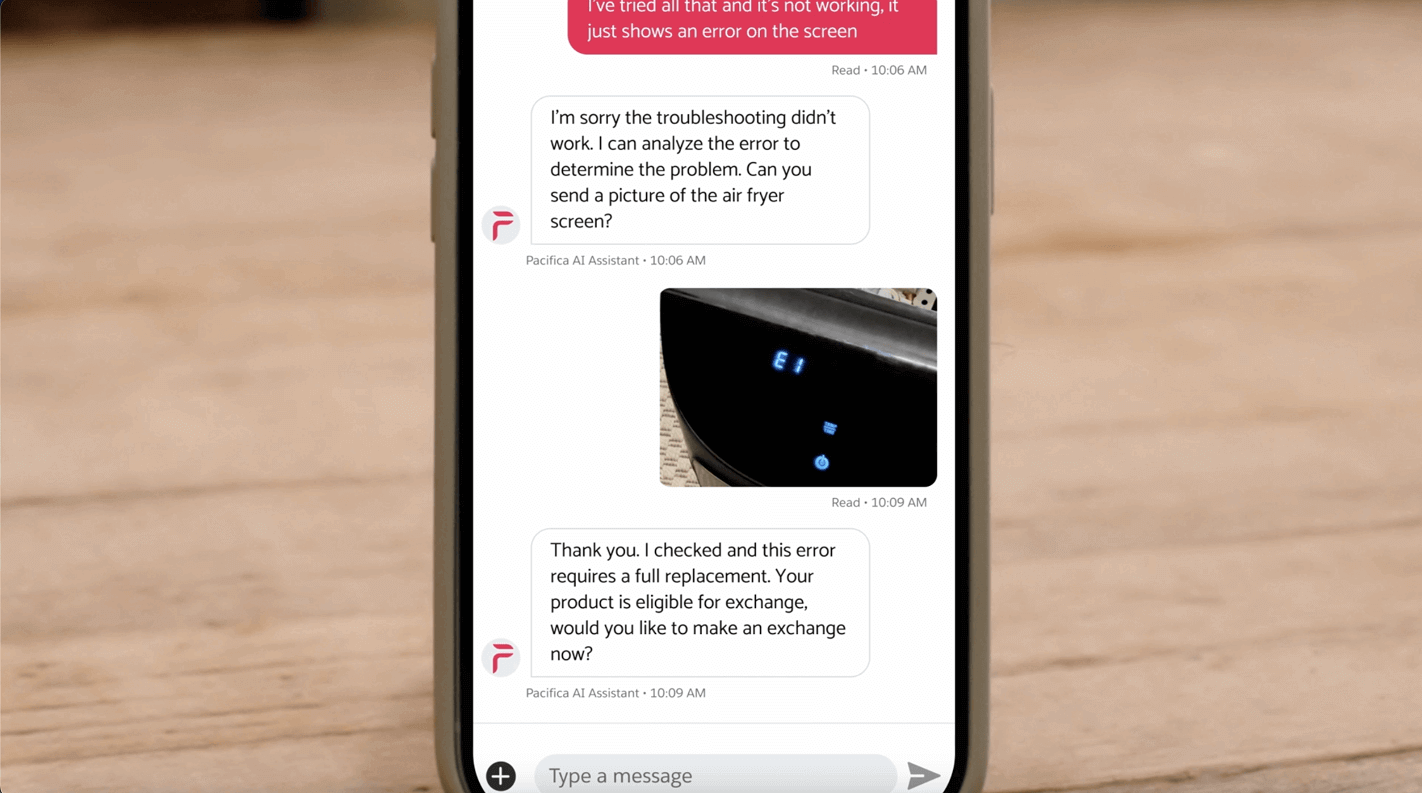
Salesforce offers a large and growing library of prebuilt agents you can switch on and adapt without writing code, plus the tools to build your own. Here are some of the common ones.
Source: salesforce.com
Service Agent
Handles customer support around the clock, grounded in your CRM data. It answers routine questions in a natural, conversational way and passes trickier cases to the right human team.
Sales Development Representative (SDR) Agent
Works your leads by answering product questions, handling objections, and booking meetings from CRM and external data. It can operate across channels such as SMS and WhatsApp, speak multiple languages, and hand off to a human whenever you decide.
Sales Coach Agent
Runs personalized role-play sessions so reps can practice their pitch and objection handling for specific deals, with feedback drawn from CRM data and past interactions.
Personal Shopper Agent
Acts as a digital concierge on ecommerce sites and messaging apps, offering tailored product recommendations and answering shopper questions as they come up.
Campaign Optimizer Agent
Looks after the whole campaign lifecycle, from briefs and audience segments to content and customer journeys in Flow, while tracking KPIs and suggesting improvements along the way.
Employee-facing agents
Beyond customer-facing roles, Agentforce also covers internal, employee-facing work. That includes Agentforce Coworker and agents for HR questions, IT onboarding, and case management, which take routine requests off your team’s plate. The library keeps expanding, and Salesforce is building a partner network so you can deploy agents from companies like Google, AWS, and IBM as well.
Planning an Agentforce rollout?
From ready-made agents to fully custom builds, we’ll help you pick the right pricing model, ground your agents in clean data, and get them live inside Salesforce, without the trial and error.
How is Agentforce different from Einstein and chatbots?
This is the part that confuses most people, so let me keep it simple.
A traditional chatbot follows a fixed script. It matches your message to a branch in a decision tree and gives you whatever sits at the end of that branch. Ask it something the script did not anticipate and it falls over.
Einstein is Salesforce’s built-in, assistive AI. It predicts, drafts, tags, and summarizes to help a person work faster, for example by suggesting a next best action or writing a first draft of a reply. It surfaces useful intelligence, but it waits for a human to act on it.
Agentforce is agentic, so it does not rely on a scripted flow at all. It reasons through the request with Atlas, grounds itself in your Data 360 records, and then takes the action itself, whether that means updating a record, sending an email, or booking a meeting. It can also string several steps together and bring in a person whenever your guardrails call for it. The simplest way to think about it is that a chatbot replies to you, Einstein helps your team work faster, and Agentforce goes ahead and finishes the task.
What can Agentforce do? Use cases by industry
Agentforce works across industries, but it is easiest to picture the value one sector at a time. Here are a few examples of where teams are putting it to work.
Financial services and banking
Guiding customers through involved processes such as opening an account or applying for a mortgage, giving service reps a single view of the customer, and keeping routine interactions compliant across every channel.
Healthcare and life sciences
Patient intake, appointment scheduling, claims-status updates, and post-care follow-ups, taking the routine queries off clinical and admin staff so they can focus on the complex cases.
Retail and ecommerce
Instant answers about availability, features, and pricing, along with tailored recommendations and quicker issue resolution on whichever channel the customer prefers.
Hospitality
Menu questions, dish suggestions, and table reservations handled instantly on web and mobile, which cuts phone volume and lets staff focus on the guests in front of them.
Manufacturing and field service
Order tracking, technical troubleshooting, and appointment scheduling, supporting both customers and field technicians with real-time product data so downtime stays low.
Public sector and education
Citizen service requests, benefit-eligibility screening, admissions and financial-aid guidance, and student or IT support, all available around the clock, consistent, and easier to audit.
These are patterns rather than guarantees. The results depend a lot on your data and how the agents are set up, which is where implementation experience really matters. To make it concrete, here are two agents we built.
Agentforce case studies: two real ENWAY builds
Both agents run inside the client’s existing Salesforce environment, with no bolt-on chatbot or separate platform to maintain. Here is what changed for each of them.
Appointment agent for a dental clinic
We replaced a costly mix of third-party scheduling tools with an Agentforce agent built on Salesforce Scheduler. It takes bookings in plain language at any hour, offers the earliest slot or a specific dentist, and writes every appointment straight into the clinic’s CRM calendar.
Read the case study →Menu & booking agent for a restaurant chain
A Salesforce Agentforce assistant now answers menu questions, filters dishes by category such as vegetarian or chef specials, and books tables at any time of day. Phone volume dropped and staff got time back for in-person service.
Read the case study →How much does Agentforce cost?
Pricing has changed quite a bit as Agentforce has matured, so the old “it’s just $2 a conversation” line no longer tells the whole story. There are now several models, and the right one depends on your use case and volume. Here is how it currently breaks down on Salesforce’s official pricing page.
| Model | Price | Best for |
|---|---|---|
| Salesforce Foundations | Free ($0) | Getting started. Includes the core building tools (Agentforce Builder, Prompt Builder, Agent Script) and a starter allocation of credits to test with. |
| Flex Credits | $500 / 100k credits | Scaling across any use case. Each Agentforce action uses about 20 credits (roughly $0.10), and Voice actions use more. Works for both customer- and employee-facing agents. |
| Conversations | $2 / conversation | Flat, predictable pricing for customer-facing agents (pre-purchase only). |
| Help Agent | $2 / resolution | A newer support option where you pay only when the agent resolves the issue on its own, with no handoff to a human and no unhappy customer. |
| Agentforce User License | $5 / user / month | Rolling agents out to every employee (requires Flex Credits). |
| Agentforce add-ons | from $125 / user / month | Unmetered employee agent usage for Sales, Service, and Field Service ($150 for Industries). |
| Agentforce 1 Editions | from $550 / user / month | All-in editions that bundle the add-on with a large annual Flex Credit allocation (2.5M credits per org). |
Figures from salesforce.com, current as of July 2026. Salesforce notes that pricing can change, so confirm on the live pricing page before you quote it. Flex Credits and Conversations cannot be combined in the same org, and most real-world deployments also need Data 360, which has its own cost.
The practical path is to start for free through Salesforce Foundations, prove the value on a real use case, and then pick the model that matches how you actually operate. Before you commit, Salesforce’s Agentforce ROI Calculator is a useful way to sanity-check the numbers.
What are the limitations of Agentforce? Is it worth it?
Agentforce is genuinely capable, but it is not magic, and it helps to go in clear-eyed about a few things.
- Agents are only as good as their data. Grounding in Data 360 is what keeps answers accurate, so if your data is messy or scattered, plan to clean and unify it first.
- It is a real project, not a switch you flip. Getting an agent production-ready, with its topics, actions, guardrails, and channels properly defined, takes genuine work, and out-of-the-box accuracy improves a lot once you tune it.
- Usage-based cost needs watching. Consumption pricing can be hard to forecast at scale, and while Salesforce’s Digital Wallet lets you track credits and set alerts, you still need budgeting discipline.
- It works best inside the Salesforce ecosystem. The value is strongest when your workflows already live in Salesforce, and a heavily non-Salesforce stack will need more integration work up front.
So is it worth it? For teams already on Salesforce with reasonably clean data and a clear, high-volume use case, the return can be strong, especially if you start on the free tier. In our experience, the projects that struggle are the ones that skip the data and scoping work, not a shortcoming of the platform itself.
How do you get started with Agentforce?
Start small and specific. Pick one high-volume, well-understood use case, such as order status, tier-one support, or lead qualification. Stand up an agent on the free Foundations tier, ground it in clean data, and measure it against a real baseline. Once it proves itself, expand from there.
That first phase of scoping and grounding is where most of the value, or the wasted effort, gets decided. It is also where a good partner saves you time and keeps the risk down.
Why implement Agentforce with ENWAY
We are a Salesforce implementation and development partner, and our focus is getting AI into production rather than stopping at a demo.
- 5-star rated on Salesforce’s official marketplace
- 150+ Salesforce projects delivered across Europe, the US, the UK, and the UAE
- Certified Salesforce consultants and developers across Sales Cloud, Service Cloud, and Data 360
- Fixed-scope Agentforce QuickStart packages that get you live fast, with a clear path to scale
Frequently asked questions
Agentforce is Salesforce’s platform for building autonomous AI agents. Unlike a scripted chatbot, an agent can reason through a request, use your trusted data, take real actions in your systems, and hand off to a human when needed, across sales, service, marketing, commerce, and internal operations.
A chatbot follows a fixed script and breaks when you go off it. Agentforce uses the Atlas Reasoning Engine to interpret the request, ground itself in your live data, and complete multi-step actions on its own, adapting in real time rather than following a fixed decision tree.
You can start for free through Salesforce Foundations. Beyond that, Salesforce offers consumption pricing (Flex Credits at $500 per 100,000 credits, or Conversations at $2 each) and per-user licensing (from $5 per user per month, with add-ons and all-in editions above that). The best model depends on your use case and volume, and most deployments also need Data 360. Always confirm current figures on the Salesforce pricing page.
Yes. Salesforce Foundations gives eligible Salesforce customers the core building tools and an initial credit allocation to test Agentforce at no cost, so you can prove a use case before committing to a paid model.
Atlas is the reasoning core behind Agentforce. It breaks a request into logical steps, decides which data and actions are needed, retrieves the relevant records, and carries out the task, deciding on its own whether to answer, update a record, or escalate to a human.
In practice, yes. Agentforce runs inside the Salesforce platform and works best when your core data and workflows already live there, grounded in Data 360 and running across the Salesforce clouds and Slack. It can still reach out to non-Salesforce systems like SAP or Oracle through MuleSoft, External Services, and open APIs, though that takes more setup.
Final Thoughts
Agentforce has moved quickly, going from launch to Agentforce 360 in about a year, and it now sits at the center of Salesforce’s platform strategy. The promise is real, with agents that can reason, act, and take work off your team’s plate across service, sales, and internal operations. The catch is just as real: the results you get track the quality of your data and your implementation far more than the marketing.
The sensible move is to start free, prove a single use case, and grow from there. And if you would rather skip the trial and error, that is exactly what we help with.
👉 Learn about Agentforce implementation with ENWAY.