


Salesforce’s platform has long evolved beyond being just a CRM. Today, it’s a full ecosystem of business tools, with Agentforce AI agents as one of its flagship innovations. But what actually makes an AI agent work? To understand this, it helps to look at the anatomy of an Agentforce agent, which includes the components that allow it to understand requests, reason about them, and take action.
In this article, we break down the key parts of an Agentforce agent and show how they work together. We also share several demo examples, including a restaurant agent that answers menu questions and books tables, and a dental clinic agent that helps manage appointments.
What is Agentforce?
An Agentforce agent is an AI assistant built on the Agentforce platform from Salesforce. It can help users complete tasks and answer questions inside Salesforce. Unlike simple chatbots, an Agentforce agent can understand context and work with data from different Salesforce tools.
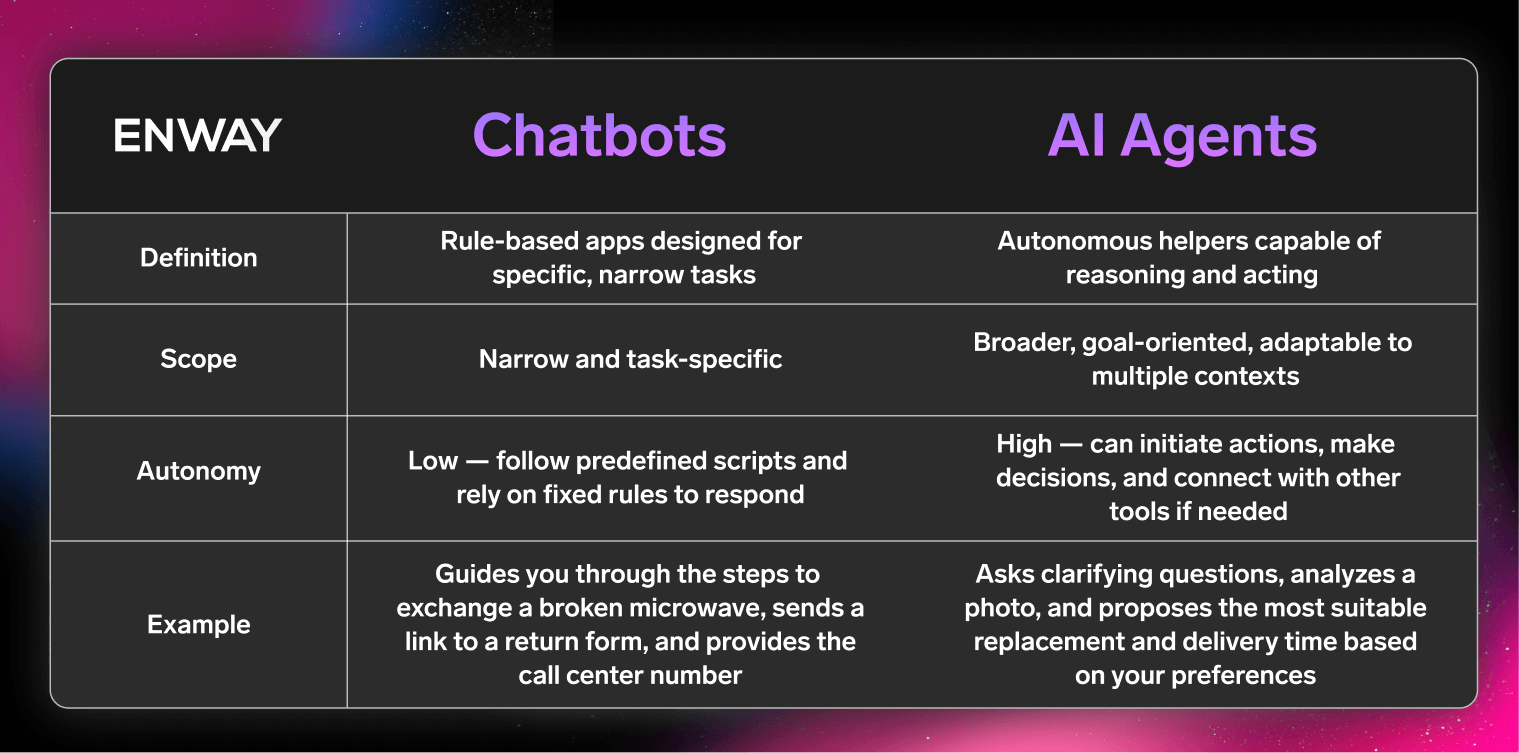
It can also take action, such as updating records, starting workflows, or helping service teams respond to customers. Companies can configure these agents for many use cases, including customer support, sales tasks, and internal help for employees. Want to learn more? Read our full article about Agentforce.
Agentforce Agent Anatomy
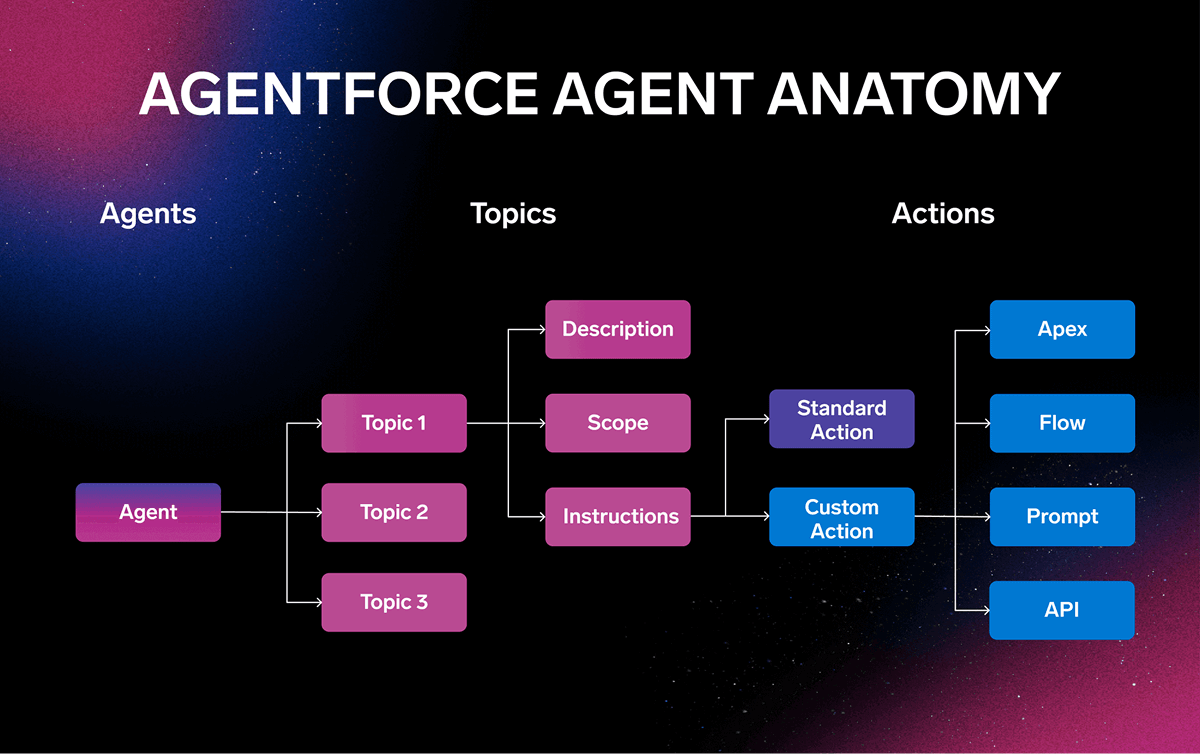
But what makes an AI agent an AI agent? Here is the anatomy of a basic Agentforce agent. Let’s explore all the building blocks.
- The agent is the brain of the system. It’s the smart AI assistant that interacts with users, understands their requests, and decides what to do next inside Salesforce.
- Topics define what the agent can do. Each topic represents a specific task or capability, such as booking an appointment, checking availability, or answering common questions. Topics help the agent understand which path to follow during a conversation.
- The classification description tells the agent when to use a topic. The Agentforce reasoning engine analyzes the user’s request and selects the most relevant topic. Clear descriptions help the agent choose the right topic at the right time.
- Scope sets the limits of a topic. It defines what the agent is allowed to handle and what is outside of its responsibility. This keeps the agent focused and prevents incorrect responses.
- Instructions tell the agent how to act within a topic. They define rules, steps, and behavior before any action is taken. This is where the logic of the agent is shaped.
- Actions are how the agent executes decisions. After the agent understands the request and selects the right topic, actions are what turn that decision into a real result inside Salesforce. Standard actions are predefined and included by default, covering common use cases. Custom actions are used when standard actions are not enough. They allow the agent to run custom logic, follow complex processes, or connect to other systems. Custom actions are built using Flow, Apex, Prompts, and API integrations.
- Flows handle step-by-step processes. They are used when the agent needs to follow a defined sequence, validate inputs, or guide a process from start to finish. Flows are visual and easy to adjust as requirements change.
- Apex is used for advanced backend logic. It supports complex rules, calculations, and integrations that cannot be handled with standard tools or flows alone.
- Prompt Templates are reusable, data-driven instruction sets for generative AI inside Salesforce. They are built around specific use cases and include the context the LLM needs to generate dynamic, context-aware responses.
- API Integration allows the agent to connect with Mulesoft, Heroku, or external systems. The agent can send and receive data through APIs to complete actions outside Salesforce.
Augment your team
with AI
ENWAY is a 5-star Salesforce implementation partner, completing projects in Europe, the US, the UK, and the Emirates. We make Agentforce implementation fast and easy for you.
Agent’s Anatomy in Action
Here is a demo video where we show a restaurant agent that understands natural language, answers questions about the menu, and books tables based on human input. Read the full success story here.
In another video, we show how an Agentforce AI appointment agent can help a dental clinic manage appointments. Explore the full success story.
Final Thoughts
AI agents are transforming the way businesses interact with customers and manage everyday tasks. With Agentforce from Salesforce, companies can create agents that understand natural language, access business data, and take action across different workflows.
And remember, ENWAY is here to help with your Agentforce implementation, even if you’re not sure where to start.
👉 Click here to learn more about Agentforce implementation with ENWAY.
